
How to Write a High-Quality Hospitality or Culinary Case Study for Journal Publication
How to Write a High-Quality Hospitality or Culinary Case Study for Journal Publication: A Practical Guide for Researchers and Industry Professionals
Case studies have long been one of the most valuable forms of scholarship in hospitality, tourism, and culinary education. Unlike purely theoretical research, case studies allow researchers and industry professionals to examine real-world situations, analyze practical challenges, and provide evidence-based solutions that can improve professional practice.
In the hospitality and culinary sectors, many innovative ideas, management strategies, destination development initiatives, restaurant concepts, and service innovations emerge directly from industry practice. Unfortunately, valuable experiences often remain undocumented and never become part of the scholarly literature.
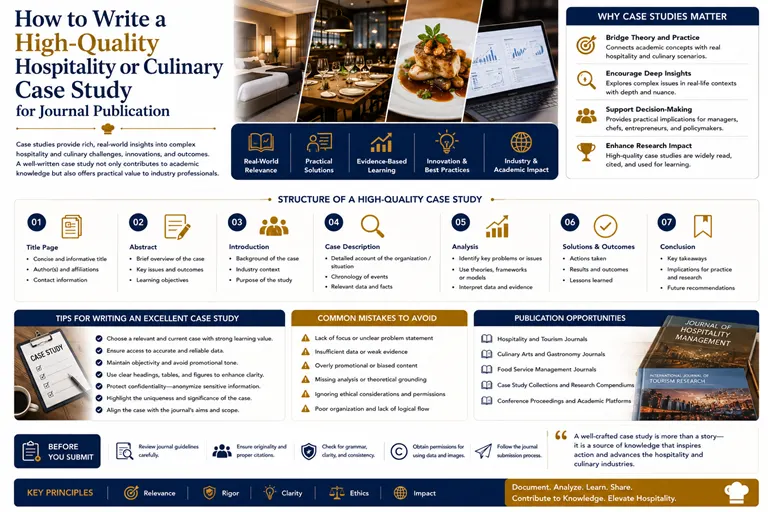
A well-written case study bridges this gap between theory and practice. It transforms practical experiences into academic knowledge that can benefit educators, researchers, students, and industry professionals worldwide.
At Re-IMAGINE The Journal for Hospitality, Tourism & Culinary Professionals, we encourage researchers, educators, chefs, hotel managers, tourism professionals, and entrepreneurs to document their experiences and contribute meaningful case studies that advance knowledge in hospitality and culinary sciences.
What Is a Hospitality or Culinary Case Study?
A case study is an in-depth examination of a specific organization, event, program, destination, innovation, management issue, or practical experience within a real-life context.
Case studies in hospitality and culinary research may focus on:
- Hotels and resorts
- Restaurants and food businesses
- Tourism destinations
- Culinary enterprises
- Event management initiatives
- Sustainability projects
- Hospitality technology implementation
- Customer experience innovations
- Educational interventions
- Entrepreneurship and startup stories
The primary objective is to generate practical insights and transferable lessons for the broader hospitality and tourism community.
Why Case Studies Are Important in Hospitality Research
Hospitality and culinary industries are highly practice-oriented fields. Many management challenges and innovative solutions cannot be fully understood through surveys or experimental studies alone.
High-quality case studies help:
- Document industry best practices
- Explain complex management situations
- Generate new theories and ideas
- Provide practical recommendations
- Support hospitality education
- Encourage evidence-based decision-making
- Preserve institutional and culinary knowledge
Case studies also create valuable teaching resources for hospitality management and culinary education programs.
Characteristics of a High-Quality Case Study
A publishable case study should possess the following characteristics:
Relevance
The case should address an important issue in hospitality, tourism, or culinary practice.
Originality
The study should present new insights, innovative practices, or unique experiences.
Evidence-Based Analysis
The article should rely on data, observations, interviews, documents, or operational evidence.
Practical Value
The findings should provide lessons that can be applied by other organizations or professionals.
Scholarly Contribution
The case should contribute to existing knowledge and stimulate further research.
Choosing the Right Case Topic
Selecting an appropriate topic is one of the most important steps.
Potential case study topics include:
- Sustainable hotel operations
- Culinary innovation and menu development
- Restaurant turnaround strategies
- Tourism destination recovery
- Heritage tourism initiatives
- Technology implementation in hotels
- Customer experience transformation
- Food entrepreneurship success stories
- Community-based tourism projects
- Hospitality education innovations
The best case studies address practical problems that have broader academic and industry significance.
Types of Hospitality and Culinary Case Studies
Descriptive Case Studies
These studies describe a particular organization, event, or phenomenon.
Exploratory Case Studies
These investigate emerging issues and generate new insights.
Explanatory Case Studies
These seek to explain why certain outcomes occurred.
Comparative Case Studies
These compare multiple organizations, destinations, or interventions.
Teaching Case Studies
These are designed specifically for educational purposes and classroom discussion.
Recommended Structure of a Hospitality Case Study
Although journals may have specific requirements, the following structure is widely accepted.
Title
The title should be clear, concise, and informative.
Example:
Digital Transformation and Guest Experience Innovation in a Luxury Hotel in India: A Case Study.
Abstract
The abstract should briefly explain:
- Background of the case
- Objectives
- Methods used
- Key findings
- Practical implications
Keep the abstract concise and informative.
Keywords
Include 4 to 6 keywords that accurately reflect the study.
Examples:
- Hospitality Management
- Case Study
- Culinary Innovation
- Tourism Development
- Guest Experience
- Sustainability
Introduction
The introduction should:
- Describe the background of the issue.
- Explain why the case is important.
- Present the research objectives.
- State the significance of the study.
Literature Review
A case study should still engage with existing literature.
The review should:
- Discuss previous studies.
- Identify knowledge gaps.
- Explain how the case contributes to current understanding.
Methodology
The methodology section should clearly explain:
- Case selection process
- Data collection methods
- Interview procedures
- Observations
- Document analysis
- Ethical considerations
- Data analysis techniques
Transparency improves the credibility of the study.
Case Description
This section should provide sufficient context.
Include:
- Organization profile
- Location and setting
- Historical background
- Industry context
- Key stakeholders
- Timeline of events
The reader should fully understand the environment in which the case occurred.
Findings and Analysis
This is the most important section of the paper.
Present:
- Major observations
- Challenges encountered
- Actions taken
- Outcomes achieved
- Supporting evidence
- Tables or figures where appropriate
Avoid merely describing events. Analyze why and how things happened.
Discussion
The discussion should:
- Connect findings with existing literature.
- Explain theoretical implications.
- Highlight managerial implications.
- Identify lessons learned.
This section demonstrates the scholarly value of the case study.
Practical Implications
Hospitality and culinary journals particularly value practical recommendations.
Discuss:
- What industry professionals can learn.
- Whether the approach can be replicated.
- Recommendations for managers and policymakers.
Conclusion
Summarize:
- Major findings
- Contributions
- Limitations
- Future research opportunities
The conclusion should provide a clear take-away message.
References
Include only reliable and relevant sources.
Follow the journal's prescribed referencing style carefully.
Data Sources for Hospitality Case Studies
Researchers may use:
- Interviews
- Company reports
- Government publications
- Tourism statistics
- Observation notes
- Industry documents
- Customer reviews
- Financial reports
- Archival records
- Social media content
Using multiple sources improves research validity.
Common Mistakes to Avoid
Lack of Clear Research Objectives
Every case study should answer specific questions.
Excessive Storytelling
Narratives are important, but academic analysis is essential.
Insufficient Evidence
Claims should be supported by reliable data.
Weak Literature Review
The study should connect with existing scholarship.
Lack of Practical Contribution
Readers should gain actionable insights from the research.
Ignoring Ethical Issues
Researchers should protect confidentiality and obtain appropriate permissions.
Emerging Areas for Hospitality and Culinary Case Studies
The rapidly evolving hospitality industry offers numerous opportunities for case study research.
Promising areas include:
- Artificial intelligence in hospitality
- Sustainable tourism initiatives
- Culinary entrepreneurship
- Smart hotels
- Experience design
- Gastronomy tourism
- Food sustainability
- Digital marketing strategies
- Crisis management
- Heritage hospitality projects
- Wellness tourism
- Hospitality education innovations
Why Publish Hospitality Case Studies?
Publishing case studies offers several benefits:
- Knowledge sharing
- Professional recognition
- Academic contribution
- Institutional visibility
- Industry impact
- Teaching resource development
- Evidence-based management practices
Case studies often inspire further research and encourage collaboration between academia and industry.
Publishing Your Hospitality or Culinary Case Study
Re-IMAGINE The Journal for Hospitality, Tourism & Culinary Professionals welcomes high-quality case studies that address emerging challenges, innovations, and best practices in hospitality, tourism, and culinary sciences.
We encourage submissions related to:
- Hospitality Management
- Culinary Innovation
- Tourism Development
- Gastronomy
- Sustainability
- Hospitality Technology
- Entrepreneurship
- Service Innovation
- Hospitality Education
- Destination Management
Case studies from industry practitioners are particularly encouraged because they provide valuable real-world insights that enrich scholarly understanding.
Frequently Asked Questions
What is the ideal length of a hospitality case study?
Most academic case studies range between 3,000 and 7,000 words, depending on journal requirements.
Can industry professionals publish case studies?
Yes. Hospitality journals increasingly encourage submissions from practitioners and industry experts.
Do case studies require statistical analysis?
Not necessarily. Many case studies rely on qualitative methods such as interviews, observations, and document analysis.
Can a single hotel or restaurant become a publishable case study?
Absolutely. If the case provides meaningful insights and broader lessons, a single organization can form the basis of an excellent scholarly article.
Are culinary entrepreneurship case studies suitable for publication?
Yes. Entrepreneurship, innovation, and food business transformation are growing areas of hospitality research.
Conclusion
Case studies are among the most valuable forms of scholarship in hospitality and culinary research because they connect academic inquiry with real-world practice. They provide detailed insights into complex situations, document innovative solutions, and generate practical lessons that can benefit both researchers and industry professionals.
As the hospitality and tourism industry continues to evolve through technological innovation, sustainability initiatives, and changing consumer expectations, there is an increasing need for well-designed case studies that capture these transformations.
Re-IMAGINE The Journal for Hospitality, Tourism & Culinary Professionals invites researchers, educators, chefs, hotel professionals, entrepreneurs, and tourism practitioners to share their experiences and contribute high-quality case studies that advance hospitality knowledge and professional practice.
By documenting real-world experiences and transforming them into scholarly contributions, case study authors can play an important role in shaping the future of hospitality, tourism, and culinary education.