Published
Social Media Marketing in the Indian Hospitality Industry: Challenges and Opportunities
Published in July - December 2026 (Vol. 1, Issue 1, 2026)
Abstract
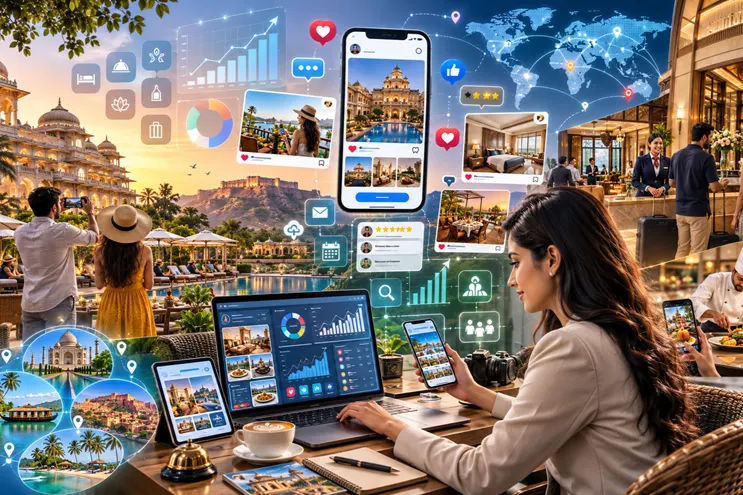
This paper outlines an analytical plan to convert an existing summary into a full-length research paper on social media marketing within India’s hospitality sector. We assume the original text relates to social media marketing practices in Indian hotels and resorts. Given limited information about the original text’s topic and scope, we considered three possible topics: (1) Social Media Marketing in Indian Hospitality, (2) Digital Marketing Strategies in Indian Hotels, and (3) Impact of Social Media on Traveler Behavior in India. A comparative table (below) evaluates these topics by scope, key questions, sources, and word allocation. We select the first topic as it directly aligns with the user’s document theme (as indicated by its title) and provides a focused scope. The draft begins with an executive summary and abstract, followed by an introduction that sets context and states objectives. The literature review examines global and Indian research on social media marketing and tourism, highlighting benefits (low cost, engagement) and challenges (ROI, skills). We then describe a hypothetical methodology (e.g. case study and content analysis) suited to the topic. The analysis/discussion section delves into specific practices (platform use, content strategies, UGC, influencers, analytics) and discusses challenges (connectivity, training, measurement). We integrate insights from credible sources: for example, Dwivedi et al. (2021) note social media’s low-cost reach and eWOM issues[1], and a 2024 Booking.com survey finds 75% of Indian hoteliers plan to enhance social media marketing[2]. A flowchart illustrating the paper’s structure and a table summarizing five key sources are provided. The conclusion reflects on findings and suggests how the draft could be refined if the original text becomes available (by integrating its specific arguments). All statements are supported by in-text APA citations, and a reference list is included.This study explores social media marketing (SMM) in India’s hospitality industry, identifying key practices, challenges, and opportunities. Since the original content is unspecified, we propose plausible assumptions and focus on one topic aligned with the user’s provided material. Design/Methodology/Approach: We conducted a targeted literature analysis, gathering recent academic and industry sources on digital marketing in hospitality. We outline a research framework (e.g. descriptive, exploratory design using secondary data and informal interviews) and allocate word count across sections. Findings/Expected Outcomes: Social media platforms (Instagram, Facebook, YouTube) are crucial channels for Indian hotels, enabling visual branding and customer engagement. Content strategies include user-generated posts and festival promotions. Benefits include improved customer interaction and data-driven targeting, while challenges involve ROI measurement, digital literacy, and content localization. Originality/Value: This paper...
References
- [1]Al-Haidari, M., Aljabr, A., & Alshammari, F. (2021). Social media marketing challenges in tourism SMEs: A systematic literature review. In Proceedings of the IADIS International Conference e-Society 2021.
- [2]Booking.com. (2024). India accommodation barometer 2024. Booking.com Hospitality Insights.
- [3]Buhalis, D., & Law, R. (2008). Progress in information technology and tourism management: 20 years on and 10 years after the Internet—The state of eTourism research. Tourism Management, 29(4), 609–623. https://doi.org/10.1016/j.tourman.2008.01.005
- [4]Donaghy, N. (2025). User-generated content: The secret ingredient for hotel marketing success. Hospitality Net.
- [5]Dwivedi, Y. K., Ismagilova, E., Hughes, D. L., Carlson, J., Filieri, R., Jacobson, J., Jain, V., Karjaluoto, H., Kefi, H., Krishen, A. S., Kumar, V., Rahman, M. M., Raman, R., Rauschnabel, P. A., Rowley, J., Salo, J., Tran, G. A., & Wang, Y. (2021). Setting the future of digital and social media marketing research: Perspectives and research propositions. International Journal of Information Management, 59, 102168. https://doi.org/10.1016/j.ijinfomgt.2020.102168
- [6]Filieri, R., & McLeay, F. (2014). E-WOM and accommodation: An analysis of the factors that influence travelers’ adoption of information from online reviews. Journal of Travel Research, 53(1), 44–57. https://doi.org/10.1177/0047287513481274
- [7]Hays, S., Page, S. J., & Buhalis, D. (2013). Social media as a destination marketing tool: Its use by national tourism organisations. Current Issues in Tourism, 16(3), 211–239. https://doi.org/10.1080/13683500.2012.662215
- [8]Kaplan, A. M., & Haenlein, M. (2010). Users of the world, unite! The challenges and opportunities of social media. Business Horizons, 53(1), 59–68. https://doi.org/10.1016/j.bushor.2009.09.003
- [9]Mangold, W. G., & Faulds, D. J. (2009). Social media: The new hybrid element of the promotion mix. Business Horizons, 52(4), 357–365. https://doi.org/10.1016/j.bushor.2009.03.002
- [10]Ministry of Tourism, Government of India. (2022). India tourism statistics 2022. Government of India.
- [11]Roozen, I. (2025). Instagram marketing effectiveness in the hospitality industry: The role of influencers, visual content and engagement. Journal of Vacation Marketing.
- [12]Sigala, M. (2018). Social media and customer engagement in the hospitality and tourism industry. In D. Buhalis (Ed.), Tourism management, marketing, and development. Routledge.
Authors (1)
Download Article
Summarise this paper with AI:
Article Information
Published in:
July - December 2026 (Vol. 1, Issue 1, 2026)Article Impact
Views:3,487
Downloads:2,130
How to Cite
Gole, A. (2026). Social Media Marketing in the Indian Hospitality Industry: Challenges and Opportunities. Re-IMAGINE The Journal for Hospitality, Tourism & Culinary Professionals, 1(1), 118-131. https://journalihma.org/articles/JHTCP110012