
Published
Assessing the Importance of Electric Vehicles in Advancing Sustainable Tourism and Hospitality: A Case Study of IHCL (Indian Hotels Company Limited)
,
Published in July - December 2026 (Vol. 1, Issue 1, 2026)
Keywords
Abstract
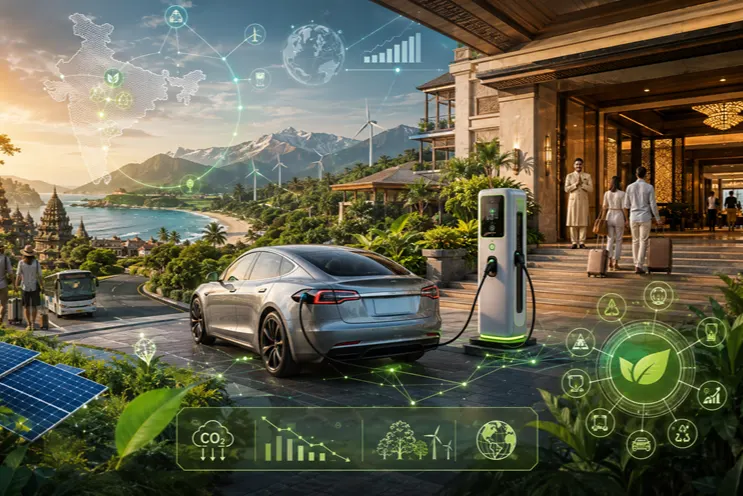
Sustainability should not only be considered as a buzzword but rather a strong way to showcase your commitment and overall desire to play a crucial role in preserving the planet for the future generations. India has always been a ‘Vishwa Guru’ ‘Global Leader’ when it comes to the commitment for the sustainability, ecofriendly behavior and overall respect and sensitivity towards Mother Nature for thousands of years. Indian hospitality industry has also showed its commitment in the last few decades by adopting ecofriendly products, using renewable source of energies, creating awareness about the commitment towards clean and green planet and relying on the principles of 3 R (Reduce, Re use & Recycle). Further the Indian government’s commitment to achieve carbon neutrality by 2070 is strongly supported by all the industries, which is highly appreciated by the global economies. The current research attempts to highlight the demand of new upcoming concept of ‘Greener Holidays’ which have made sustainable mobility the need of an hour, where almost all domestic and global hospitality chains are striving to tap this upcoming segment. Sustainable mobility is going to be the major revolution in the tourism & hospitality industry and IHCL i.e. Taj group of Hotels have already gone out of the way to tap this segment showcasing their strong commitment towards sustainability and ESG framework. IHCL and its commitment towards nature and sustainability is highly commendable, and further the promotion of EV vehicles will reposition the brand IHCL as a major contributor of sustainability. The major objective of the research is to study the scope, and potential of sustainable mobility and EV vehicles in the Indian tourism & hospitality industry. The study also attempts to highlight the commitment of Taj group towards sustainability under Paathya initiative and its impact on overall brand image of IHCL. The study is qualitative in nature and used case study method by taking IHCL as the company to understand scope and potential of sustainable mobility and the use of EV vehicles in the Indian hospitality industry context. The major findings of the study highlights that EVs are the future of the mobility in the Indian tourism & Hospitality industry and IHCL has played a major role in showing its overall commitments towards sustainability under ‘Paathya Initiative’ and how sustainable mobility even contributes for the brand image & customer satisfaction. The present study is highly applicable in the current scenario of the Indian Tourism & Hospitality Industry as the industry is going through a major transformation especially in the field of transport and mobility.
References
- [1]Adepetu, A., & Keshav, S. (2017). The relative importance of price and driving range on electric vehicle adoption: Los Angeles case study. Transportation, 44(2), 353–373.
- [2]Aguilera-García, A., Gomez, J., & Sobrino, N. (2020). Exploring the adoption of moped scooter sharing systems in Spanish urban areas. Cities, 96, 102424.
- [3]Al-Aomar, R., & Hussain, M. (2017). An assessment of green practices in a hotel supply chain: A study of UAE hotels. Journal of Hospitality and Tourism Management, 32, 71–81.
- [4]Asadi, S., Pourhashemi, S. O., Nilashi, M., Abdullah, R., Samad, S., Yadegaridehkordi, E., Aljojo, N., & Razali, N. S. (2020). Investigating influence of green innovation on sustainability performance: A case on Malaysian hotel industry. Journal of Cleaner Production, 258, 120860.
- [5]Axsen, J., & Sovacool, B. K. (2019). The roles of users in electric, shared and automated mobility transitions. Transportation Research Part D: Transport and Environment, 71(1), 1–21.
- [6]Ayre, J. (2016). Top-Selling Car in Norway Is an Electric SUV, EVs 29% of Sales. Retrieved from https://cleantechnica.com/2016/06/13/top-selling-car-norway-electric-suv-evs-29-sales/
- [7]BCG, & Google. (2017). Demystifying the Indian Online Traveller. Retrieved from https://media-publications.bcg.com/BCG-Google-Demystifying-the-Indian-online-traveler-Jun-2017.pdf
- [8]Ben-Akiva, M., Bierlaire, M., & Steg, L. (2026). The behavioral dimension of transport decarbonization. npj Sustainable Mobility and Transport.
- [9]Bloomberg New Energy Finance. (2018). Electric Vehicle Outlook 2018.
- [10]Bleier, A., Harmeling, C. M., & Palmatier, R. W. (2019). Creating Effective Online Customer Experiences. Journal of Marketing, 83(2), 98–119.
- [11]Calabrese, A., Costa, R., Levialdi, N., & Menichini, T. (2019). Integrating sustainability into strategic decision-making: A fuzzy AHP method for the selection of relevant sustainability issues. Technological Forecasting and Social Change, 139, 155–168.
- [12]Cervini, G., Burra, L. T., & Gkritza, K. (2026). The impact of temperature on battery electric vehicle penetration. npj Sustainable Mobility and Transport.
- [13]Cheng, X., Ran, Y., & Wang, T. (2026). Replacement of internal combustion engine vehicles by electric vehicles in Chinese ridesharing markets. npj Sustainable Mobility and Transport.
- [14]Cohen, S. A., & Hopkins, D. (2019). Autonomous vehicles and the future of urban tourism. Annals of Tourism Research, 74, 33–42. https://doi.org/10.1016/j.annals.2018.10.009
- [15]EHL. (2022). What Will the Hospitality Industry Look Like in 2030? EHL Group, Switzerland. Retrieved from https://hospitalityinsights.ehl.edu/hospitality-industry-2030
- [16]Gössling, S., & Lund-Durlacher, D. (2021). Tourist accommodation, climate change and mitigation: An assessment for Austria. Journal of Outdoor Recreation and Tourism, 34, 100367.
- [17]Graci, S., & Dodds, R. (2008). Why go green? The business case for environmental commitment in the Canadian hotel industry. Anatolia, 19(2), 251–270.
- [18]Han, H., Hsu, L. T. J., & Sheu, C. (2010). Application of the theory of planned behavior to green hotel choice: Testing the effect of environmental friendly activities. Tourism Management, 31(3), 325–334.
- [19]Jones, P., Hillier, D., & Comfort, D. (2014). Sustainability in the global hotel industry. International Journal of Contemporary Hospitality Management, 26(1), 5–17. https://doi.org/10.1108/IJCHM-10-2012-0180
- [20]Karunakar, B. (2016). Changing Paradigms in the Taxi Industry in India. ACADEMICIA: An International Multidisciplinary Research Journal, 6(5), 93–133.
- [21]Koroma, M. S., & Alwosheel, A. (2026). Aligning vehicle electrification with power sector transitions: Life cycle insights across diverse grids. npj Sustainable Mobility and Transport, 3. https://doi.org/10.1038/s44333-025-00076-y
- [22]Kuffer, F., & Brecht, L. (2012). Managing Product Variety Decisions for Sustainable Profitability in B2B Industries. International Journal of Technology Marketing, 7(3), 287–305.
- [23]MacInnes, I. (2005). Dynamic Business Model Framework for Emerging Technologies. International Journal of Services Technology and Management, 6(1), 3–19.
- [24]Page, S., & Ge, Y. (2009). Transportation and Tourism: A Symbiotic Relationship? In T. Jamal & M. Robinson (Eds.), The SAGE Handbook of Tourism Studies. London: Sage.
- [25]Ramgade, A., & Kumar, A. (2021). Changing Trends of Hospitality Industry: Emergence of Millennials and Gen Z as Future Customers and Their Influence on the Hospitality Industry. Vidyabharati International Interdisciplinary Research Journal, 12(01), 336–342.
- [26]Ramgade, A., & Kumar, A. (2021). Futuristic Hotels: A Study on Evolution and Growth of Smart Hotels. Vidyabharati International Interdisciplinary Research Journal, 12(02), 117–120.
- [27]Wang, R., Zhong, C., & Guan, S. (2026). Recent developments of automated vehicles and local policy implications. npj Sustainable Mobility and Transport.
Authors (2)
Prasad Nawale
IHM – AurangabadIHM – AurangabadIHM – AurangabadIHM – Aurangabad
View all publications →Saurabh Krishna
IHM – AurangabadIHM – AurangabadIHM – AurangabadIHM – Aurangabad
View all publications →Download Article
Summarise this paper with AI:
Article Information
Published in:
July - December 2026 (Vol. 1, Issue 1, 2026)Article Impact
Views:3,574
Downloads:2,082
How to Cite
Nawale, P., & Krishna, S. (2026). Assessing the Importance of Electric Vehicles in Advancing Sustainable Tourism and Hospitality: A Case Study of IHCL (Indian Hotels Company Limited). Re-IMAGINE The Journal for Hospitality, Tourism & Culinary Professionals, 1(1), 53-70. https://journalihma.org/articles/JHTCP110009