
Published
Investigating the Role of Grains, Pulses, Thermal Time, and Lipids in preparing the Nutritionally Complete and Perfect Khichdi
Published in July - December 2026 (Vol. 1, Issue 1, 2026)
Keywords
Abstract
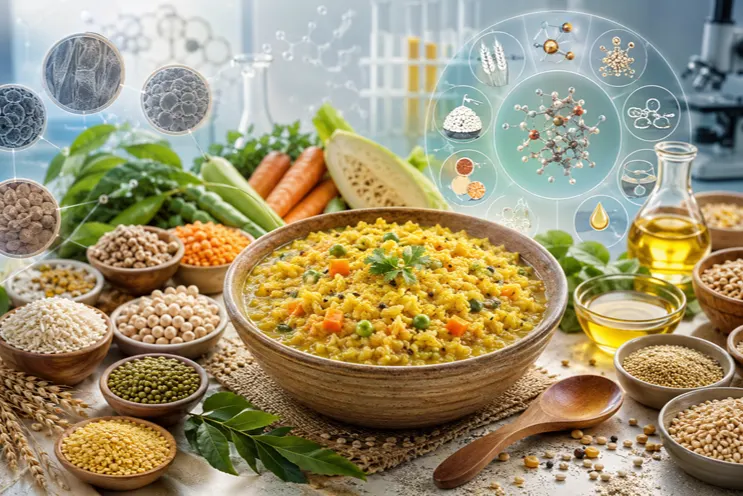
For a structurally sophisticated dish such as khichdi, we have done it a great disfavour by equating it to comfort food or food to be served to convalescing individuals. Sometimes khichdi also gets relegated to the role of being considered a culinary minimalist creation. In the arguments put forward through this article, the author intends to demonstrate that despite the general nonchalance afforded to khichdi, it will be very evident after examining all the data available at hand that a khichdi is actually a complex, nutritionally engineered product that uses various interdependent variables that are set within the framework of a coherent food system. These variables are and are not limited to the demonstration of an amalgamation of grains, pulses, spice architecture, a lipid medium, and thermal duration function as a coalescing unit for interdependent variables within what is technically an extremely coherent food system. The endurance of khichdi as a beloved food of the masses, a fact that skips the typical roadblocks of class and in the Indian context, the class system points to a culinary dish that should not be viewed as a simple combination of ingredients but as a symbol of empirical precision that is built into and embedded within essential culinary practice. The fascination with khichdi is enhanced by a simple and logical look at its longevity at being at the centre of research. A basic khichdi is composed of very few ingredients and yet it has remained relevant both culturally and physically across varying contexts. It has remained constant despite changes in culinary trends and fashions, shifts in nutritional paradigms and beyond the evolution of agricultural systems. The khichdi has also traversed and stayed consistent within the frameworks of modern nutritional discourses and stretching way back to Vedic period ritual economies via route of British colonial reimagination, and Mughal royal kitchens. This is easily demonstrated by the fact that the variables themselves ensure that the decision to work out as to what could be a ‘perfect’ khichdi could be arrived at more from a contextual lens rather than one that is universal. Because, to these variables, we can also add individual digestive states and capacities, sociocultural framing, and specific metabolic demand of individuals. From the ancient texts that have focused on glycaemic modulation, complementarity of the cereal and pulses and their ratios, and a bioavailability of phytochemicals that appear to be lipid-mediated, to the latter-day dismissal by British historians as a ‘humble porridge’, Indo-Persian records and contemporary nutritional science that believes it to be a superfood, the multi-faceted complexities of a khichdi need to be unravelled in a phased manner. This research paper aims to work on one such specific aspect.
References
- [1]Anitha, S., Givens, D. I., Botha, R., Kane-Potaka, J., Sulaiman, N. L., Tsusaka, T. W., ... Bhandari, R. K. (2021). Calcium from Finger Millet—A Systematic Review and Meta-Analysis on Calcium Retention, Bone Resorption, and In Vitro Bioavailability. Sustainability.
- [2]Avilés-Gaxiola, S., Chuck-Hernández, C., & Saldívar, S. O. (2017). Inactivation Methods of Trypsin Inhibitor in Legumes: A Review. Journal of Food Science, 17–29.
- [3]Avilés-Gaxiola, S., Chuck-Hernández, C., Rocha-Pizaña, M. D., García-Lara, S., López-Castillo, L. M., & Serna-Saldívar, S. O. (2018). Effect of thermal processing and reducing agents on trypsin inhibitor activity and functional properties of soybean and chickpea protein concentrates. LWT, 98, 629–634.
- [4]B, M., RK, J., A, S., S, D., U, B., S, S., ... SK, B. (2025). Harnessing the potential of millets for climate-resilient and sustainable agriculture. Frontiers in Plant Science.
- [5]Bakker, A. B., & Demerouti, E. (2007). The Job Demands‐Resources model: State of the art. Journal of Managerial Psychology, 309–328.
- [6]Balyatanda, S. B., Gowda, N. A., Subbiah, J., Chakraborty, S., Prasad, P. V., & Siliveru, K. (2024). Physiochemical, Bio, Thermal, and Non-Thermal Processing of Major and Minor Millets: A Comprehensive Review on Antinutritional and Antioxidant Properties. Foods.
- [7]Battutah, I. (2003). The Travels of Ibn Battutah. Picador.
- [8]Baum, T. (2019). Does the hospitality industry need or deserve talent? International Journal of Contemporary Hospitality Management, 31(10), 3823–3837.
- [9]Belhassen, Y., & Shani, A. (2012). Hotel workers’ substance use and abuse. International Journal of Hospitality Management, 1292–1302.
- [10]Bharati, A. (1963). Pilgrimage in the Indian Tradition. History of Religions, 3(1), 135–167.
- [11]Bhavsar, G. C., & Bhatt, D. L. (2014). Ghee (Clarified Butter) and Its Role in Traditional Indian Nutrition and Ayurvedic Medicine. Journal of Ethnic Foods, 30–38.
- [12]Blochmann, H. (2010). The Ain I Akbari of Abul Fazl 'Allami. Gorgias Press.
- [13]Braun, V., & Clarke, V. (2006). Using thematic analysis in psychology. Qualitative Research in Psychology, 77–101.
- [14]British Hospitality Association. (2022). Hospitality Workforce Report 2022: People and Skills. UK Hospitality.
- [15]Bush, D. M., & Autry, J. H. (2002). Substance abuse in the workplace: Epidemiology, effects, and industry response. Occupational Medicine, 13–25.
- [16]Bush, K., Kivlahan, D. R., & McDonell, M. B. (1998). The AUDIT Alcohol Consumption Questions (AUDIT-C): An Effective Brief Screening Test for Problem Drinking. Archives of Internal Medicine, 1789–1795.
- [17]Cano, M. (2019). Masculinity in the Kitchen: Gender Performance in the Culinary Arts Industry. ProQuest.
- [18]Charaka, & Drdhabala. Charaka Samhita. Chaukhamba Publications.
- [19]Chun-Fang Chiang, K.-J., & Brown, B. The Impact of Employee Training on Job Satisfaction and Intention to Stay in the Hotel Industry. Journal of Human Resources in Hospitality & Tourism, 4(2), 99–118.
- [20]Collier, G., McLean, A., & O'Dea, K. (1984). Effect of co-ingestion of fat on the metabolic responses to slowly and rapidly absorbed carbohydrates. Diabetologia, 26, 50–54.
- [21]Creswell, J. W., & Clark, V. L. (2018). Designing and Conducting Mixed Methods Research. Sage Publications.
- [22]CT, S., S, A., V, K., & RK, S. (2021). Pearl Millet: A Climate-Resilient Nutricereal for Mitigating Hidden Hunger and Provide Nutritional Security. Frontiers in Plant Science.
- [23]Davis, M. (2001). Late Victorian Holocausts. Verso.
- [24]Dayrit, F. M. (2014). The Properties of Lauric Acid and Their Significance in Coconut Oil. Journal of the American Oil Chemists' Society.
- [25]Deery, M., & Jago, L. (2015). Revisiting talent management, work-life balance and retention strategies. International Journal of Contemporary Hospitality Management, 27(3), 453–472.
- [26]Demerouti, E., Bakker, A. B., Nachreiner, F., & Schaufeli, W. B. (2001). The Job Demands-Resources Model of Burnout. Journal of Applied Psychology, 86(3), 499–512.
- [27]Dhingra, S., & Jood, S. (2002). Physico-chemical and nutritional properties of cereal-pulse blends for bread making. Nutrition and Health.
- [28]Diwekar, R. (2009). Don't Lose Your Mind, Lose Your Weight. Random House.
- [29]Djourova, N. P., Molina, I. R., & Abate, G. (2019). Self-Efficacy and Resilience. Journal of Leadership & Organizational Studies.
- [30]Drouard, A. (2015). Histoire des Cuisiniers en France. CNRS Editions.
- [31]Druckman, C. (2010). Why Are There No Great Women Chefs? Gastronomica.
- [32]Edmondson, A. (1999). Psychological Safety and Learning Behavior in Work Teams. Administrative Science Quarterly.
- [33]Ferguson, P. P. (2006). Accounting for Taste. University of Chicago Press.
- [34]Fine, G. A. (1996). Kitchens: The Culture of Restaurant Work. University of California Press.
- [35]Frone, M. R. (1999). Work Stress and Alcohol Use. Alcohol Research and Health.
- [36]Frone, M. R. (2008). Are work stressors related to employee substance use? Journal of Applied Psychology, 93(1), 199–206.
- [37]Fu, L., Gao, S., & Li, B. (2023). Impact of Processing Methods on the In Vitro Protein Digestibility and DIAAS. Foods.
- [38]Fuglie, L. J. (2001). The Miracle Tree. Church World Service.
- [39]Gautam, D. S., Srivastava, A., Urmaliya, N., Hardeniya, P., & Gupta, R. (2025). Ayurveda Dietetics and Food Technology. International Journal in Contemporary Research in Multidisciplinary.
- [40]Ghafoorunissa. (1994). Dietary Fats and Heart Diseases: The Indian Context. National Medical Journal of India.
- [41]Ghafoorunissa. (1996). Fats in Indian Diets and Their Nutritional and Health Implications. Lipids.
- [42]Ghosh, A. (2022). An Overview of Indian Culinary Journey with a Glimpse of Regional Cuisine. Bulletin of Culinary Art and Hospitality.
- [43]Ghosh, M., Das, B., Mahata, D., & Ghose, T. K. (2018). Morpho-agronomic and molecular characterization of Gobindabhog. Indian Journal of Plant Genetic Resources.
- [44]Gopalan, C., Sastri, B. V., & Balasubramanian, S. C. (2004). Nutritive Value of Indian Foods. National Institute of Nutrition.
- [45]Gupta, R. (2026). Makar Sankranti Khichdi History. Patrika.
- [46]Gurusamy, S., Vidhya, C. S., Kasherao, B. Y., & Shanmugam, A. (2022). Pulses for Health. Applied Food Research.
- [47]Hall, G. B., Dollard, M. F., & Coward, J. (2010). Psychosocial Safety Climate. International Journal of Stress Management.
- [48]Han, F., Moughan, P. J., Li, J., Stroebinger, N., & Pang, S. (2021). The Complementarity of Amino Acids in Cooked Pulse/Cereal Blends. Plants.
- [49]Harris, D. A., & Giuffre, P. (2015). Taking the Heat. Rutgers University Press.
- [50]Harter, J. K., Schmidt, F. L., Asplund, J. W., Killham, E. A., & Agrawal, S. (2010). Causal Impact of Employee Work Perceptions. Perspectives on Psychological Science.
- [51]Heidari, H., Bagherniya, M., Majeed, M., Sathyapalan, T., Jamialahmadi, T., & Sahebkar, A. (2023). Curcumin-piperine Co-supplementation and Human Health. Phytotherapy Research.
- [52]Hobfoll, S. E. (1989). Conservation of Resources. American Psychologist.
- [53]Hochschild, A. R. (1983). The Managed Heart. University of California Press.
- [54]Iyer, U. M., & Mani, U. V. (1990). Effect of Curry Leaves Supplementation. Plant Foods for Human Nutrition.
- [55]Juliano, B. O. (1993). Rice in Human Nutrition. FAO.
- [56]Julier, A., & Lindenfeld, L. (2006). Mapping Men Onto the Menu. Food & Foodways.
- [57]Kakarala, M., Brenner, D. E., Korkaya, H., et al. (2009). Targeting Breast Stem Cells with Curcumin and Piperine. Breast Cancer Research and Treatment.
- [58]Kamboj, R., & Nanda, V. (2017). Nutritional Profile and Health Benefits of Legumes. Legume Research.
- [59]Karasek, R. A. (1979). Job Demands, Job Decision Latitude, and Mental Strain. Administrative Science Quarterly.
- [60]Karasek, R. (1990). Lower Health Risk with Increased Job Control. Journal of Organizational Behavior.
- [61]Kelly, R. R., & Robbins, D. H. (1980). Evaluation of the Resistance of Lysine Sulfite to Maillard Destruction. Journal of Agricultural and Food Chemistry.
- [62]Kensbock, S., Jennings, G., Bailey, J., & Patiar, A. (2014). Distinction Work and Its Consequences for Women. Hospitality & Society.
- [63]Kroenke, K., Spitzer, R. L., & Williams, J. B. (2001). The PHQ-9. Journal of General Internal Medicine.
- [64]Lad, V. (2004). Ayurveda: The Science of Self Healing. Lotus Press.
- [65]Larsen, S., & Jørgensen, H. (2003). Do Hotel and Restaurant Students Drink More? Food Service Technology.
- [66]Lestienne, I., Icard-Vernière, C., Mouquet, C., Picq, C., & Trèche, S. (2005). Effects of Soaking Whole Cereal and Legume Seeds. Food Chemistry.
- [67]Lucas, R. (2004). Employment Relations in the Hospitality and Tourism Industry. Routledge.
- [68]Mal, B., Padulosi, S., & Ravi, S. B. (2010). Minor Millets in South Asia. Bioversity International.
- [69]Manchanda, S. C., & Passi, S. J. (2016). Selecting Healthy Edible Oil in the Indian Context. Indian Heart Journal.
- [70]Manohar, P. (2015). Backing up Ayurveda with Good Science. Ancient Science of Life.
- [71]Maslach, C. (2016). Maslach Burnout Inventory Manual. Mind Garden.
- [72]Maslach, C., Leiter, M. P. (2008). Early Predictors of Job Burnout and Engagement. Journal of Applied Psychology.
- [73]Maslach, C., & Jackson, S. E. (1981). The Measurement of Experienced Burnout. Journal of Organizational Behavior.
- [74]Mathijssen, A. J., Lisicki, M., Prakash, V. N., & Mossige, E. J. (2023). Culinary Fluid Mechanics and Other Currents in Food Science. Reviews of Modern Physics.
- [75]McGee, H. (2004). On Food and Cooking. Scribner.
- [76]Messina, M. J. (1999). Legumes and Soybeans. American Journal of Clinical Nutrition.
- [77]Narayan, S. (2020). Food and Faith. Harper Collins.
- [78]National Restaurant Association. (2022). Restaurant Industry 2030. National Restaurant Association Educational Foundation.
- [79]ND, D., & Gonuguntla, B. N. S. V. Y. (2024). Review of Medicinal Plants with Carminative Properties. International Journal of Biology, Pharmacy, and Allied Sciences.
- [80]BBC News. (2018). Anthony Bourdain: Celebrity Chef Found Dead at 61.
- [81]Norström, T., Sundin, E., & Leifman, H. (2012). Hazardous Drinking Among Restaurant Workers. Scandinavian Journal of Public Health.
- [82]Pant, P. (2024). History of Khichdi in India. Food Files.
- [83]Platel, K., & Srinivasan, K. (2024). Digestive Stimulant Action of Spices. Indian Journal of Medical Research.
- [84]Pratten, J. D. (2003). The Training and Retention of Chefs. International Journal of Contemporary Hospitality Management.
- [85]Puranik, S., Kam, J., Sahu, P. P., et al. (2017). Harnessing Finger Millet to Combat Calcium Deficiency. Frontiers in Plant Science.
- [86]Reddy, N. (1985). Dry Bean Protein Digestibility. Journal of Food Science.
- [87]Reddy, N. R., Pierson, M. D., Sathe, S. K., & Salunkhe, D. K. (1985). Dry Bean Tannins. Journal of the American Oil Chemists' Society.
- [88]Robinson, R. N., Solnet, D. J., & Breakey, N. (2014). Chefs’ Occupational Commitment. International Journal of Hospitality Management.
- [89]Saleh, A. S., Zhang, Q., Chen, J., & Shen, Q. (2013). Millet Grains: Nutritional Quality, Processing, and Potential Health Benefits. Comprehensive Reviews in Food Science and Food Safety.
- [90]Schaufeli, W. B., Leiter, M. P., & Maslach, C. (2009). Burnout: 35 Years of Research and Practice. Career Development International.
- [91]Seth, A. (2025). Millets in India: Exploring Historical Significance, Cultural Heritage and Ethnic Foods. Journal of Ethnic Foods.
- [92]Shapira, N. (2019). The Metabolic Concept of Meal Sequence vs. Satiety. Nutrients.
- [93]Shoba, G., Joy, D., Joseph, T., et al. (1998). Influence of Piperine on the Pharmacokinetics of Curcumin. Planta Medica.
- [94]Siegrist, J. (1996). Adverse Health Effects of High-Effort/Low-Reward Conditions. Journal of Occupational Health Psychology.
- [95]Siegrist, J. (2002). Effort-Reward Imbalance at Work and Health. Research in Occupational Stress and Well Being.
- [96]Siegrist, J., Starke, D., Chandola, T., et al. (2004). The Measurement of Effort–Reward Imbalance at Work. Social Science & Medicine.
- [97]Singh, A. (2007). Action and Reason in the Theory of Ayurveda. AI & Society.
- [98]Spitzer, R. L., Kroenke, K., & Williams, J. B. (2006). The GAD-7. Archives of Internal Medicine.
- [99]Srinivasan, K. (2005). Spices as Influencers of Body Metabolism. Food Research International.
- [100]Suni, S. S., Pillai, D. S., & Nair, V. P. (2021). An Ayurvedic View on Food (Ahara). Biology and Life Sciences Forum.
- [101]Sushruta, & Bishagratna. (1907). Sushruta Samhita.
- [102]Taylor, J. R., Schober, T. J., & Bean, S. R. (2006). Novel Food and Non-food Uses for Sorghum and Millets. Journal of Cereal Science.
- [103]USDA FoodData Central. (2026). U.S. Department of Agriculture.
- [104]Verma, A. (2025). Sacred Foodways: The Economic and Cultural Implications of Khichdi Distribution in Govind Ghat. Enroute Indian History.
- [105]Williams, N. (2014). PHQ-9. Occupational Medicine.
- [106]Wilson, M. L., & VanBuren, R. (2022). Leveraging Millets for Developing Climate Resilient Agriculture. Plant Biotechnology.
- [107]Young, V. R., & Pellett, P. (1994). Plant Proteins. American Journal of Clinical Nutrition.
- [108]Yule, H., & Burnell, A. (1886). Hobson-Jobson. John Murray.
- [109]Zhang, W., Boateng, I. D., Xu, J., & Zhang, Y. (2024). Proteins from Legumes, Cereals, and Pseudo-Cereals: Composition, Modification, Bioactivities, and Applications. Foods.
Authors (1)
Zubin D’Souza
IHM – AurangabadIHM – AurangabadIHM – AurangabadIHM – Aurangabad
View all publications →Download Article
Summarise this paper with AI:
Article Information
Published in:
July - December 2026 (Vol. 1, Issue 1, 2026)Article Impact
Views:2,437
Downloads:631
How to Cite
D’Souza, Z. (2026). Investigating the Role of Grains, Pulses, Thermal Time, and Lipids in preparing the Nutritionally Complete and Perfect Khichdi. Re-IMAGINE The Journal for Hospitality, Tourism & Culinary Professionals, 1(1), 1-26. https://journalihma.org/articles/JHTCP110007
Article Actions
More from this Issue
Examining the Critical Role of Supply Chain Management in the Success of Farm-to-Table Systems in India
Chef Thottapayil PramodRead more →